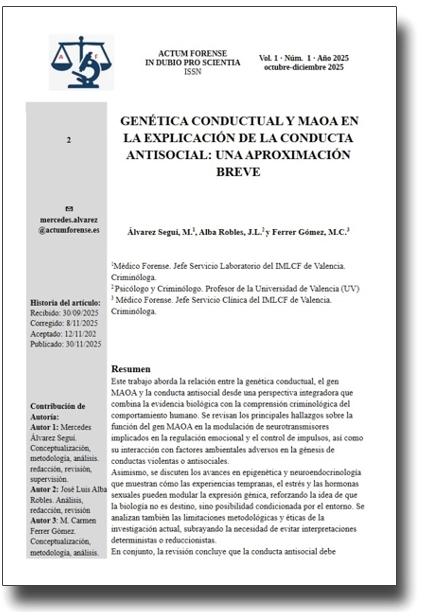
Genética conductual y MAOA en la explicación de la conducta antisocial: una aproximación breve
DOI:
https://doi.org/10.68000/actumf.v1i1.2Palabras clave:
genética conductual, MAOA, conducta antisocial, epigenética, criminología, neurobiologíaResumen
Este trabajo aborda la relación entre la genética conductual, el gen MAOA y la conducta antisocial desde una perspectiva integradora que combina la evidencia biológica con la comprensión criminológica del comportamiento humano. Se revisan los principales hallazgos sobre la función del gen MAOA en la modulación de neurotransmisores implicados en la regulación emocional y el control de impulsos, así como su interacción con factores ambientales adversos en la génesis de conductas violentas o antisociales.
Asimismo, se discuten los avances en epigenética y neuroendocrinología que muestran cómo las experiencias tempranas, el estrés y las hormonas sexuales pueden modular la expresión génica, reforzando la idea de que la biología no es destino, sino posibilidad condicionada por el entorno. Se analizan también las limitaciones metodológicas y éticas de la investigación actual, subrayando la necesidad de evitar interpretaciones deterministas o reduccionistas.
Citas
Brunner, H. G., Nelen, M., Breakefield, X. O., Ropers, H. H. & van Oost, B. A. (1993). Abnormal behaviour associated with a point mutation in the structural gene for monoamine oxidase A. Science, 262(5133), 578-580.
Byrd, A. L. & Manuck, S. B. (2014). MAOA, childhood maltreatment, and antisocial behavior: Meta-analysis of a gene–environment interaction. Biological Psychiatry, 75(1), 9-17. https://doi.org/10.1016/j.biopsych.2013.05.004
Caspi, A., McClay, J., Moffitt, T. E., Mill, J., Martin, J., Craig, I. W. & Poulton, R. (2002). Role of genotype in the cycle of violence in maltreated children. Science, 297(5582), 851-854. https://doi.org/10.1126/science.1072290
Checknita, D., Bendre, M., Ekström, T. J., Comasco, E., Tiihonen, J., Hodgins, S. & Nilsson, K. W. (2020). Monoamine oxidase A genotype and methylation moderate the association of maltreatment and aggressive behaviour. Behavioural brain research, 382, 112476.
Ducci, F., Bevilacqua, L., Landi, P. & Goldman, D. (2012). Genetic Variation Within Serotonin Genes, Hormones, and Aggression. In Multiple Origins of Sex Differences in Brain: Neuroendocrine Functions and their Pathologies (pp. 81-102). Berlin, Heidelberg: Springer Berlin Heidelberg.
Fergusson, D. M., Boden, J. M., Horwood, L. J., Miller, A. & Kennedy, M. A. (2012). MAOA, abuse exposure and antisocial behaviour: 30-year longitudinal study. British Journal of Psychiatry, 200(6), 435-440. https://doi.org/10.1192/bjp.bp.111.097139
Gerardo-Valles, P. N., Cano-González, B. F., García-Pardo, D. M., Garza-Santillano, B. E., González-Sandoval, A. L. & Lazalde, B. (2024). The influence of MAOA gene variants and hormonal regulation on aggression and psychiatric vulnerabilities. GSC Advanced Research and Reviews, 21(2), 464-468. https://doi.org/10.30574/gscarr.2024.21.2.0448
GSC Online Press. (2024). The Influence of MAOA Gene Variants and Hormonal Regulation on Aggression and Psychiatric Vulnerabilities. https://gsconlinepress.com/journals/gscarr/sites/default/files/GSCARR-2024-0448.pdf
Jara-Ortega, P., Jara-Crespo, F. & Jara-Ortega, N. (2022). Genotipo polimórfico del gen MAOA y comportamiento antisocial en adolescentes y adultos varones. Revista Ecuatoriana de Neurología, 31(3).
Kanarik, M., Sakala, K., Matrov, D., Kaart, T., Roy, A., Ziegler, G. C. & Harro, J. (2023). MAOA methylation is associated with impulsive and antisocial behaviour: dependence on allelic variation, family environment and diet. Journal of Neural Transmission, 131(1), 59-71. https://doi.org/10.1007/s00702-023-02675-w
Kim-Cohen, J., Caspi, A., Taylor, A., Williams, B., Newcombe, R., Craig, I. W., & Moffitt, T. E. (2006). MAOA, maltreatment, and gene–environment interaction predicting children’s mental health: New evidence and a meta-analysis. Molecular Psychiatry, 11(10), 903-913. https://doi.org/10.1038/sj.mp.4001851
Szyf, M. (2013). DNA methylation, behaviour and early life adversity. Journal of Genetics and Genomics, 40 (7), 331-338. https://doi.org/10.1016/j.jgg.2013.06.004
Wagels L, Votinov M, Hüpen P, Jung S, Montag C, Habel U. Single-Dose of Testosterone and the MAOA VNTR Polymorphism Influence Emotional and Behavioral Responses in Men During a Non-social Frustration Task. Front Behav Neurosci. 2020 Jun 25; 14:93. doi: 10.3389/fnbeh.2020.00093. PMID: 32670031; PMCID: PMC7330109.
Waltes, R., Chiocchetti, A. G., & Freitag, C. M. (2016). The neurobiological basis of human aggression: a review on genetic and epigenetic mechanisms. American Journal of Medical Genetics Part B: Neuropsychiatric Genetics, 171(5), 650-675.
Widom, C. S., Brzustowicz, L. M., & Reiss, D. (2015). MAOA, childhood maltreatment, and antisocial behavior in females: Results from a prospective study. Biological Psychiatry, 77(9), 830–836 https://doi.org/10.1016/j.biopsych.2014.11.022
Descargas
Publicado
Número
Sección
Licencia
Derechos de autor 2025 Actum Forense

Esta obra está bajo una licencia internacional Creative Commons Atribución-NoComercial-SinDerivadas 4.0.